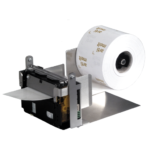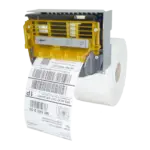
Linerless printing – a real challenge
Only available in German language
Published in: ident Magazin, ident Verlag, issue 4, 2019
- How does printing on liner-free paper work?
- What paper properties are necessary for printing on „linerless“ labels to be successful?
- What exactly makes cutting off self-adhesive labels without a backing material so difficult and why is it possible to avoid sticking the labels at all?
- And what factors generally need to be considered when printing „linerless“ to obtain the best possible printing results with the thermal printer?
Dipl.-Ing. (FH) Klaus Baldig, Development Manager at GeBE, explains why printing on linerless labels is a real challenge.
If you want to know how the solution to all the problems encountered when printing labels without a backing material, the liner-free papers, was achieved with the new GeBE COMPACT-Plus Linerless printer, read this specialist article. It is also available for download here.
„Printing “Linerless” – a real challenge. A linerless printer with a linerless cutter
Labels are printed using the thermo-direct or thermal transfer printing process; they are separated from the backing paper (liner) at a peeling edge and applied by hand or using an applicator to an object. This technique is successfully applied in areas such as retail and logistics. However, it still leaves many wishes unfulfilled. Inserting the label roll is often time-consuming and the backing paper remains as waste that must be disposed of in an environmentally responsible manner. Furthermore, it reduces the usable label stock on the roll by approximately 50%.
In the mid-1990s, the now-known linerless technology for thermal paper was patented and introduced in the USA. However, it only began to gain momentum in Germany in the retail weighing sector a little later. The idea was to do away with the expensive carrier paper and obtain at least twice as many usable labels. An additional advantage:
The label length is variable. Cutting without adhesive. On Linerless thermal paper, the adhesive layer is applied under the thermal film and, to protect against adhesive bonding of the paper layers on the roll, a silicone layer is applied – comparable to a adhesive film roll. The print is torn off or cut off. A freely accessible tear edge is easily cleaned of adhesive residue; however, the blades of the cutter come into contact with the tough adhesive and become completely sticky after a short time. Until now, there has been no satisfactory solution for this. The measuring surface must have good non-stick properties.
However, typical non-stick coatings wear off very quickly when cutting.
Previous solutions:
- Papers with adhesive-free zones within which cutting is performed (manufacturing is complex)
- Significantly reduce the adhesive strength of the adhesive (the bonding of the knives is „only“ delayed)
- Always lubricate the knife with protective silicone oil (a huge effort, only suitable for a few applications)
Ideal paper quality
It is believed that anyone who produces good labels should also be able to produce good linerless papers. However, the required precision in production is extremely high and the selection of the right components essential. The base thermal paper must:
- have a very smooth, shot-like surface so that the silicone does not penetrate too deeply into the thermal layer before it hardens and also allows for a good anchoring of the silicone.
- On the reverse side, it features a barrier against the adhesive, which migrates continuously through the paper towards the thermal side and attacks it when it reaches it.
This can take several weeks to over a year, depending on the type of paper.
In labels, the silicone sits beneath the adhesive and has no influence on the printing process. The manufacturer can focus mainly on adjusting the release properties (the required force to detach the label from the carrier) through the siliconeization process.
In linerless paper, the thickness of the silicone coating significantly affects the printing process. The layer must be as dense as possible (without holes, „pin holes“) and at the same time as thin as possible to achieve a good printing result. Tests show that most errors are made here. If there are holes, the adhesive penetrates the silicone coating and at best only damages the thermal layer. At worst, the adhesive migrates into the silicone during printing on the printhead. While silicone deposits can be easily removed, if adhesive is added, it becomes more difficult. If not cleaned in time, the printhead can be destroyed. Holes also increase the release force of the linerless paper roll – easily audible as a „knocking“ when rolling it out.
Simply applying too much silicone is the wrong approach. Because the silicone dampens the energy transfer during the printing process and the print becomes more blurred. With a layer of 1.0 μm, the print head needs approximately 16 % more energy to print as black as on standard thermal paper. Tests have shown that regarding the amount of silicone applied:
• practically do not form at 0.8 μm.
• build up gradually at 1.0 μm (after removing a few thousand tickets).
• can become so thick as early as 1.2 μm that cleaning may be necessary after only a few hundred labels to obtain a flawless print image.
The thickness of the silicone layer is tested using the „methylene blue test.“ The amount of permeability that is acceptable is up to the individual’s discretion. Still, there are papers that show no discoloration at all. Paper without a backing sticks to everything.
Therefore, all the moving parts in the printer must be made non-stick-resistant. The central element here is the printing roller. It is made from special silicone, which is mixed with the anti-stick additive. To reduce the active surface (the area for adhesive adhesion), it is often ground in a zigzag profile, but the edges quickly wear out. Not every adhesive „fits“ every anti-stick roller. The lifespan of a roller can therefore vary from 5 km to 30 km.
The selection of suitable adhesives for linerless papers is rather limited compared to conventional labels. The adhesive must adhere to the desired surface, but not to the functional parts of the printer, especially the printing roller. As with labels, the higher the adhesive thickness, the higher the adhesive strength. However, the greater the thickness, the greater the problems in the printer.
Typical order strengths for linerless adhesive are 12-15 g/m2 compared to 18-25 g/m2 for labels. With too little adhesive, the paper does not stick properly; with too much, the printer gets dirty too quickly. The tendency to contamination of functional parts increases from 12 g/m2 to 15 g/m2 adhesive by about a factor of 10. Therefore, the highest precision and consistency in the order strength are required! There are standard retail adhesives that, at less than 12 g/m2 on smooth surfaces, adhere excellently; on cardboard, however, with 15 g/m2 adhesive, they also stick poorly. The adhesive must be demonstrably suitable for linerless printers – especially in deep-freeze or logistics applications. A small, non-adhesive edge on both sides of the paper is necessary for linerless printers to prevent any adhesive from seeping outwards when the paper roll is wrapped.
Even if all of this is taken into account, you are still not immune to paper jams or more severe contaminations.
For example, linerless papers tend to have partial silicone detachments during printing, which quickly cause the print head to become dirty when handled incorrectly and can lead to failures when printing barcodes.
For good printing results, the control of the printing process must in any case be adjusted in many areas.
Only then is it possible to print hundreds of thousands of labels, and that without any service whatsoever.
Outlook
The Linerless technology has undeniable advantages and there are signs that the demand for it will increase enormously. It will certainly take a share of the label market, but it will also find new applications. Linerless papers are still offered more expensive than labels, but in the long term a reduction below the label price level is expected, because with the same production volume the material costs for Linerless are cheaper.
In addition, the disposal of the liner and the readiness of a linerless printer are significantly higher than those of a label printer. The success is therefore predetermined.
Also on the topic of „Linerless Technology by GeBE“ in „ident Products 2019/2020“, p. 88:
GeBE Linerless Technology. The solution for linerless applications“