
Protocol printers for measurement and automation technology
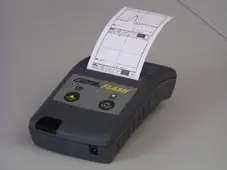
Available only in German language
published in: Electronics Information, AT Fachverlag, No. 10 – 2004
——————————————– Anhang: pi015_baldig.jpg 1b.jpg 1a.jpg 2.jpg
The HP Inkjet as the standard output device:
In the field of measurement and automation technology, it seems that people have forgotten that there are also smaller printers than those with the A4 format. Wherever you look, in vending machines, control systems, oscilloscopes and data loggers, the system software often only supports an A4 printer, usually an HP inkjet printer.
Protocol printers offer a number of advantages. A measurement protocol is not limited to A4 size. Due to the simple installation option, the printer forms a unit with the system and is better protected. Furthermore, it saves time and effort during operation and maintenance.
and support costs, for example due to compatibility issues. And a mobile printer is particularly interesting for mobile measurement systems. Modern controllers are increasingly working with standardized graphical operating systems such as Windows CE.NET. But even Windows CE.NET limits the choice of printers to an HP Inkjet (!) and an HP Laserjet.
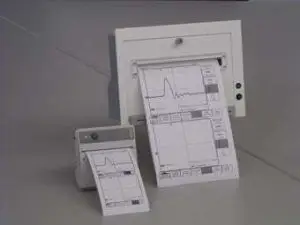
Figure 1 shows the 0.625:1 and 0.375:1 reduced expressions of an oscilloscope on an 112 mm wide GPT-6224 and a 58 mm wide GPT-4352 using the HP Inkjet driver of the measuring instrument.
What makes this type of printer so attractive alongside its low price level, and why is it now so difficult to use a small protocol printer?
PCL as standard graphics interface:
The desire for a simple, device-independent output led to the standard printer interface „PCL“ „Printer Control Language“ from Hewlett Packard, which is supported by almost every modern A4 printer.
It is certainly less the powerful commands of this language itself than the graphic formats that are used in PCL. For protocol printers this language is unusual; it is actually a language for DIN A4 printers.
The four graphic formats used here, which are to be simplified here, include the very simple bitmap format that is widely used for graphic printing. In this format, the pixel information is encoded 1:1 binary. A 1 is a point to be printed; a 0 in the data stream is therefore a white point. This format generates enormous amounts of data that must be transferred to and printed by the printer at already small resolutions. The second method is run-length encoding (RLE). Here, a counter byte indicates how often the following pixel byte is repeated. The third method is called run-length encoding (RLE). Here, a counter byte indicates how often the following pixel byte is repeated.
The TIFF Encoding method is particularly suitable for unstructured graphics such as grayscale images. It skillfully combines RLE and bitmap formats. With the Delta Row method, only the changed information from the previous line is transmitted. This can achieve compression rates of up to 10:1, especially for measuring graphs.
The PCL graphic format is optimal for line-oriented printers, which also include GeBE protocol printers. A RLE-encoded line is usually processed faster by a protocol printer than a bitmap data stream, and is therefore printed faster relative to the compression rate. Compressed data can thus compensate for the limited performance of an RS232 interface.
In the following example, a 112 mm wide 200 dpi printer is supposed to print a 20 cm long graphic: The graphic generates a data volume of 832 pixels/line-horiz. x 200 mm length x 8 pixel lines/mm = 1.3 Mbit !
This graphic can be printed at a data rate of 115 Kbit/s with a maximum of 13 mm/s. At a typical PCL compression rate of 4:1, the only remaining 33 Kbytes are then printed at approximately 50 mm/s.
Adaptation to the A4 format.
However, mastering the previously stated graphic formats is not sufficient for a protocol printer if the control is expected to output an A4 printer. The printout is formatted to a A4 page width of approximately 210 mm. With the usual 300 dpi of an inkjet printer, this corresponds to approximately 2400 pixels horizontally, while in Draft mode (150 dpi) there are still 1200 points. An example printer with a width of 58 mm and a resolution of 200 dpi would have only 384 pixels horizontally. A reduction of the printout by approximately 3 times would therefore be indispensable.
A software change in data-generating systems is usually very costly or even impossible.
The new graphics firmware of the GeBE System 78 printer family helps here.
The graphics data intended for an HP inkjet are appropriately reduced or enlarged to fit the protocol printer format. When reducing, image points are removed from the supplied graphic information so that even small graphic information, such as.
Thin lines, not lost in the design. Thus, even intricate measurement graphics can be effectively reduced in size.
Since simpler controls in many printers simply enlarge the image on the display to fit the A4 format, the image produced on the protocol printer often appears more concise than the printout on the A4 printer.
Even when implementing graphics in VGA format, the smaller protocol printer produces good results. The human eye is surprisingly tolerant of cleverly reduced image information.

To the author:
Dipl.-Ing. (FH) Klaus Baldig is Head of Development and Product Management at GeBE Elektronik und Feinwerktechnik GmbH in Germering/Munich