
Mobile printing.

Only available in German language
published in: Elektrotechnik Automation, Vogel Industrie Medien GmbH & Co. KG, issue 06/2004
Portable printers offer mobility and freedom on-site. Their usefulness is further enhanced when the data is transmitted wirelessly. The user usually has infrared or Bluetooth interfaces available. The following article presents their respective advantages and the requirements for a reliable power supply.
The wired interface is increasingly being replaced by portable printers. For wireless data transmission, infrared or Bluetooth are mainly used. It is especially important that the printer’s power management is compatible with the transmission technology.
The company GeBe Elektronik und Feinwerktechnik GmbH from Germering near Munich offers GeBE-FLASH a portable mini printer that integrates an infrared or Bluetooth interface in addition to RS232 and USB connections.
Already traditional: printing via infrared
Older mobile infrared printers use an early Hewlett Packard infrared protocol (HP Ir). It transmits unidirectionally and is therefore not error-proof. The protocol only allows transmission rates of approximately 1000 bits per second, which no longer meets the printing requirements of today.
IrDA (Infrared Data Association) is the currently most commonly used infrared transmission method. Data can be exchanged between computers, mobile phones, and corresponding printers via an IrDA interface.
The transmission of the IR signals is controlled by the so-called IrDA stack, a layered, hierarchically structured communication protocol. The lowest protocol level, the „Physical Layer“, describes the light-based transmission. The IrSIR method commonly used for printers is applied for transmission rates up to 115,200 bits per second. The specified minimum transmission distances for an IrSIR connection are one meter for standard devices and 20 cm for low-power devices. With the help of an additional infrared LED booster, much higher transmission distances are possible, provided that the other end also has such an LED booster. The „Upper Layer“ of the IrDA stack, the service protocols, establish the device-specific connection to the interface.
Setting up an IrDA stack involves a significant effort that many manufacturers have previously avoided. For easy Ir transmission, the printer GeBE-FLASH provides an Ir interface with a simple error-proof point-to-point protocol. The hardware is compatible with the IrSIR method.
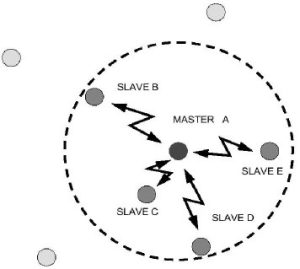
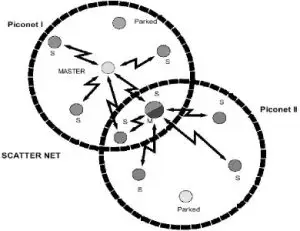
In a Piconet, the devices communicate via a master. If a master is also a slave in another Piconet, a scatter network is created.
The transmission technology of the future is called Bluetooth
The registration- and fee-free ISM (Industrial, Scientific and Medical) bands have led to a boom in data transmission via radio. They cover the three frequency ranges 0.9 MHz, 2.4 GHz and 5.8 GHz. The very common 433 MHz or 868 band is mostly used to transmit small amounts of data, for example for radio thermometers. In the 2.4 GHz range, Bluetooth or WLAN (Wireless Local Area Network) are used, while in the 5 GHz band WLAN or Hiperlan (High Performance Radio LAN) operate.
In the printing sector, Bluetooth and WLAN have emerged as the standard wireless transmission technologies; however, WLAN is mainly used only in office printers.
Bluetooth (hereinafter referred to as BT) operates in the ISM band at 2.4 GHz, which can be used freely in the USA and Europe. There are restrictions in France, Japan and Spain. The data throughput is a maximum of 721,000 bits per second. BT offers extremely high interference security through „Frequency Hopping“. This means that 1,600 channels are switched between every second. This enables sufficient high net data rates even in highly disturbed environments.
BT channels are divided into three performance classes:
h Class 1 with a transmission power of 100 mW for transmission ranges of up to 100 meters, h Class 2 with 2.5 mW for applications in the immediate vicinity up to 20 meters, suitable for example for printers, h Class 3 with 1 mW for ranges of up to 10 meters, for example for headphones.
A master-capable BT device searches its surroundings for other BT devices, the slaves. There can be up to eight active devices. A master can manage up to 256 inactive devices in standby mode; a connection between the slaves is only possible via the master. Such a radio network is called a Piconet. If a master is also a slave in another Piconet, a scatter network is created.
At BT too, a layered protocol is used to control the transmission, which is very similar to the IrDA stack. There is a hardware layer, a lower protocol layer for controlling the data flow, as well as application protocols, the so-called BT profiles.
The following profiles are used for printing applications: The Hardcopy Cable Replacement Profile (HCRP) emulates a parallel PC interface and is therefore the actual printer profile. Unfortunately, most broadcasters do not support this profile, so the Serial Port Profile (SPP) has become the most widely used one. However, it only provides a simple serial interface. All application profiles rely on this. The Basic Printing Profile (BPP) is used to transfer objects to a printer.
Power supply for mobile printers from the battery Portable printers are usually powered wirelessly using inexpensive NiMH (nickel-metal hydride) batteries or high-quality Lilon (lithium-ion) batteries. The printer, control logic, and the data transmission itself consume energy. The user expects that electronic devices are always ready to operate without needing to be turned on or off. Although the transmit power of a radio transmitter and the printing currents of a thermal printer of up to 3 A are somewhat high, they play only a minor role in the printer’s operational lifespan. The greatest amount of energy is drawn during the inactive phases.
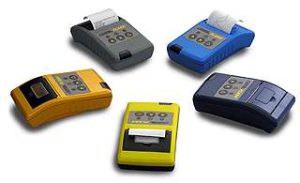
GeBE-FLASH It is already available in small series with customer-specific operating film and its own housing color.
Standby power must be low
An example: A BT printer is supposed to print 100 10 cm long B-notes over 10 hours. With an average current consumption during printing of 1 A and a printing time of about two seconds, the printer consumes 60 mAh from the battery per day. The transmission unit requires 4.2 mAh for two transmission seconds and a current consumption of 70 mA per day. With a typical standby current consumption of approximately 35 mA, the device consumes 350 mAh from the battery in 10 hours.
To address this problem of high standby power consumption, modern wireless printers can enter the sniffer mode. In this state, the printer „sleeps“; only a power-saving receiver listens in the vicinity for potential calls. GeBE-FLASH The printer activates its receiver every 1.25 seconds and „sniffs“ for potential calls from a BT master. If a master initiates an inquiry (search for other devices) or paging (response to a specific device), the printer responds. But only after establishing a direct connection does the device wake up and become operational. After a configurable inactive period, the printer disconnects and returns to the sniffer mode.
The GeBE printer consumes 25 µA in the IrDA sniffer mode, approximately 1.2 mA in the BT sniffer mode at full reception readiness, and thus drains the battery in only 10 hours by consuming 0.25 mAh or 12 mAh respectively.
Whether it’s radio or infrared, the printer’s power management must harmonize with the transmission technology. Infrared is inexpensive and flexible to use, however its range is severely limited and a direct visual connection is always necessary. The radio connection certainly has the greatest future, especially since Bluetooth technology is expected to become cheaper in the future. (uh)

Author: Dipl.-Ing. Klaus Baldig is Head of Development and Product Management at GeBE Elektronik und Feinwerktechnik GmbH in Germering/Munich.