
Thermal paper
Only available in German
published in: Elektronik Informationen, AT Fachverlag, issue 3/2005
„Thermo paper? Isn’t that the kind of paper whose print fades so quickly and which always has these wavy lines?“
This prejudice from the early 90s still plagues the thermal paper industry today. However, the technology has evolved enormously!
Today, thermal paper with a per capita annual consumption of about 5 square meters is the leading printing medium in the protocol printing sector.
„Really?“ one might ask, „and that when everything is stored digitally these days?“
Indeed! Thermal paper is on the rise.
Main drivers of growth are applications such as sales receipts at the POS, admission and ticket tickets, lottery receipts, bank statements, long-term records of physical measurements such as weather or earth movements, medical data as well as printouts of ultrasound examinations. Thermodruck is also widely used for self-adhesive labels with barcodes, e.g. labels for self-checkout fruit and vegetable scales, flight baggage tags, warehouse management, etc.
The reason for this market position lies, not least, in the high reliability, the low operating costs and the low maintenance intervals that today’s thermal printing systems offer.
Thermal printers do not require expensive ribbons, toners, or inks. The paper already includes everything needed for printing, which significantly reduces the service costs.
The pressure mechanism itself consists solely of a driven roller that passes the paper along a heating strip with hundreds of heating elements, the pressure pixels.
The simple design reduces initial costs and susceptibility to interference.
Modern thermal printers achieve a lifespan of up to 100 km of paper throughput, which is approximately 10-30 times more than that of a laser printer, for example.
In addition, the thermal printer achieves high printing speeds. In the POS area, up to 300 mm/s, and in the label printing area, even up to 500 mm/s.
The wide range of applications for thermal paper requires a product range that, in addition to being compatible with the individual thermal printers, also meets the needs of users in terms of archivalability, thickness, appearance, and printability.
To achieve these different properties, various leuco dyes, developers, stabilizers, and binders are applied to the base paper in several layers on top of each other.
Construction of thermal papers:
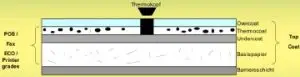
The thermosheet consists essentially of color pigments (lactones), reaction agents and melting point regulators.
Leuco dyes are natural dyes that reflect white light in an undissolved state; when developed by a developer, the leuco dyes change their energy state so that colored light is reflected. Mixtures of different dyes, for example, produce a black image.
Archivability of the expression:
Leuco dyes have the tendency to return to their initial energy state, i.e., white light. Sunlight, plasticizers, oils, and water accelerate this process.
The dyes have different strong resistance properties against the various influencing agents. As a general rule of thumb, the cheaper the starting dyes are formulated, the lower the resistance.
In Europe, thermal papers are manufactured for which manufacturers guarantee between 5 and 25 years of image readability. In Japan, papers with virtually unlimited archival durability are also produced. These values refer to standard paper storage conditions at approximately 20°C and 50% relative humidity, without direct sunlight influence.
But even coatings with UV filters have already been developed.
This graph shows the resistances of different types of thermal paper:
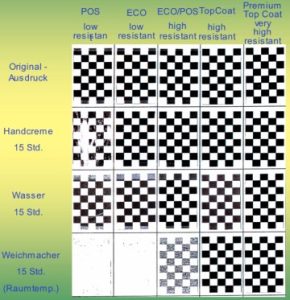
The lower the initial archival capacity, the faster the effects of the aforementioned factors manifest themselves.
Static and Dynamic Sensitivity:
To take full advantage of thermal printing, the paper must be selected in accordance with the printing system and the application.
The faster the printer works, the shorter the heat exposure time is, so the faster the image must develop. A faster printer therefore requires paper with high „dynamic sensitivity“. (Curve)
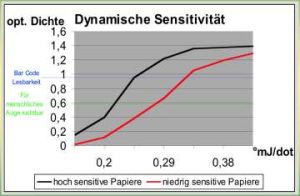
The vertical axis represents the optical density (the degree of darkening), and the horizontal axis represents the amount of energy.
Standard thermal papers start developing the image at about 70°C. There are also special papers, e.g. for the parking ticket area, whose starting temperature is 90°C or 120°C. The starting temperature function is referred to as „static sensitivity“.
Versatility of thermal papers:
Longer archival durability or a wider temperature range are just two of the ways to adapt thermal paper to a specific application. Suitable thermal papers are available for almost all requirements in the documentation technology sector. For example, there are waterproof papers for refrigeration technology or florists;
2-layer papers for generating pass-throughs in the POS area;
Forgery-proof paper for entry or travel tickets;
self-adhesive papers for labeling tasks;
colored papers, transparent thermal foils, tear-resistant paper, etc.
Even a 2-color print, e.g. red/black, is possible for better visualization.
Thermal paper and the environment: Thermal papers can and should be recycled!
Important for the use of thermal paper in connection with food is the approval of the thermal paper by the ISEGA Research and Examination Society mbH, Aschaffenburg. This independent institute examines the papers with regard to contact with food and issues a certificate (ISEGA approval) when the tests have shown that they are completely safe.
Some European manufacturers of thermal paper also hold the „Swan“ environmental certificate. The award is based on compliance with standards regarding the total emission of pollutants, even during production.
Specialized thermal paper shops such as www.thermalpaperbox.com advise their customers on choosing the appropriate paper and can also supply small quantities customized to customer requirements.
Summary statement:
The fact that the once-deadly practice of printing data is still highly relevant – on the contrary, it is actually increasing – is evident, among other things, in the enormous growth currently being experienced in mobile computing.
But not only there, but also in all conceivable stationary applications, printed data are still in demand – whether to archive information or to use it to justify actions.
It is all the more important to highlight the fact that, thanks to enormous technological progress, high-quality thermal paper now meets the necessary requirements to an absolute degree.
And the thermal printing technology behind it can, alongside other printing technologies such as inkjet, color or laser printing, already be relied on for its cost-effectiveness and resistance to interference.
Thermo printing is therefore – if the paper selection is done correctly according to the application or requirement – an extremely cost-effective and very secure way to transfer variable data to paper. And that will continue in the future too!

About the author:
Dipl.-Ing. (FH) Klaus Baldig is the development manager at GeBE.
Related topics
 Specialist contributionPaper-wrapped? Still indispensable for a long timeSpecialist contributionAgainst paper theft and manipulation of driving license issuance